
ITAD FAQs
frequently asked questions
What criteria should we use to select a reputable IT asset disposition vendor ?
Here are the key criteria to evaluate when selecting an ITAD provider:
Choosing the right IT asset disposition (ITAD) partner is a critical decision that affects data security, environmental compliance, financial recovery, and brand reputation. Many companies today are looking for ITAD vendors who deliver on sustainability gains and can quantify these gains. A reputable ITAD vendor should meet strict industry standards, demonstrate transparency, and align with your organization’s operational, regulatory, and sustainability goals.
01
Verify Industry Certifications and Regulatory Compliance
A trustworthy ITAD vendor will maintain third-party certifications that validate their processes. Look for standards such as R2v3 or e-Stewards, ISO 14001 for environmental management, ISO 9001 for quality management, and ISO 27001 for information security. These certifications demonstrate a commitment to responsible recycling, data protection, and continual improvement. Ensure the provider’s practices comply with relevant laws and regulations in your region and industry.
02
Ensure Data Security and Compliance with Recognized Standards
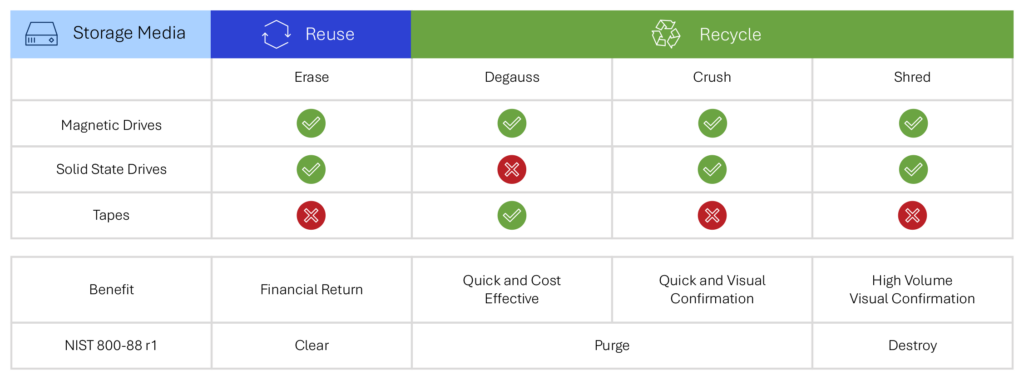
Data is destroyed by data erasure, shredding, crushing or degaussing of storage media. As shown in the chart, data erasure allows secure resale of storage devices. Magnetic hard drives and magnetic tapes, solid state drives and optical storage devices each require different data destruction methods. Certificates of Data Destruction (CODD) are provided by the vendor during the project. The CODD demonstrates compliance to corporate and regulatory requirements, including the General Data Protection Regulation (GDPR).
03
Evaluate Environmental Responsibility and Recycling Practices
A responsible ITAD vendor should prioritize reuse before recycling. This includes refurbishing and remarketing viable equipment to extend its lifecycle and reduce environmental impact. Non-reusable equipment should be recycled in accordance with certified e-waste recycling practices. Ask about the vendor’s material recovery rates, downstream vendor audits, and ability to support corporate sustainability reporting such as Scope 3 emissions data.
04
Assess Reputation, Experience, and Financial Stability
Experience in managing ITAD programs similar in scale and complexity to yours is essential. A vendor with a proven track record will better understand your operational challenges, regulatory obligations, and reporting needs. Also evaluate the company’s financial stability. Financially distressed vendors may cut corners, putting your data, compliance, and brand at risk.
05
Request Transparency and Detailed Reporting
A reputable ITAD partner will provide detailed documentation at every stage of the asset disposition process. This includes asset-level tracking, chain-of-custody records, certificates of data destruction, and environmental impact summaries. Reporting transparency is crucial for compliance audits and corporate governance.
06
Look for Strong Value Recovery Capabilities
ITAD vendors with established resale channels can recover residual value from used equipment, helping you offset the cost of ITAD services. Ask how they assess equipment value, whether you share in resale proceeds, and how settlements are documented and paid out. Strong remarketing capabilities support financial accountability and circular economy principles.
07
Evaluate Customer Service and Program Support
Customer support matters when managing a multi-site, regulated, or high-volume ITAD program. Look for vendors that offer responsive communication, customized service models, and dedicated account support. They should be able to tailor processes and reporting to match your internal workflows, asset types, and industry-specific requirements.
Making the right choice
A reputable ITAD provider will bring certified and consistent processes, clear documentation, and a customer-first approach to managing your end-of-life technology.
Let’s Collaborate
SLS engages collaboratively with global clients to re-examine business models and to plan for continual evolution towards a circular economy model. Clients leverage our knowledge about disposition of retired electronic assets, managing their movement through reverse supply chains, and quantifying the carbon impact of these assets.